EU AI Act Regulatory Sandbox: The Complete Developer Compliance Checklist (2026)
Post #1601 in the sota.io EU Compliance Series — EU AI Act Regulatory Sandbox 2026 #5/5
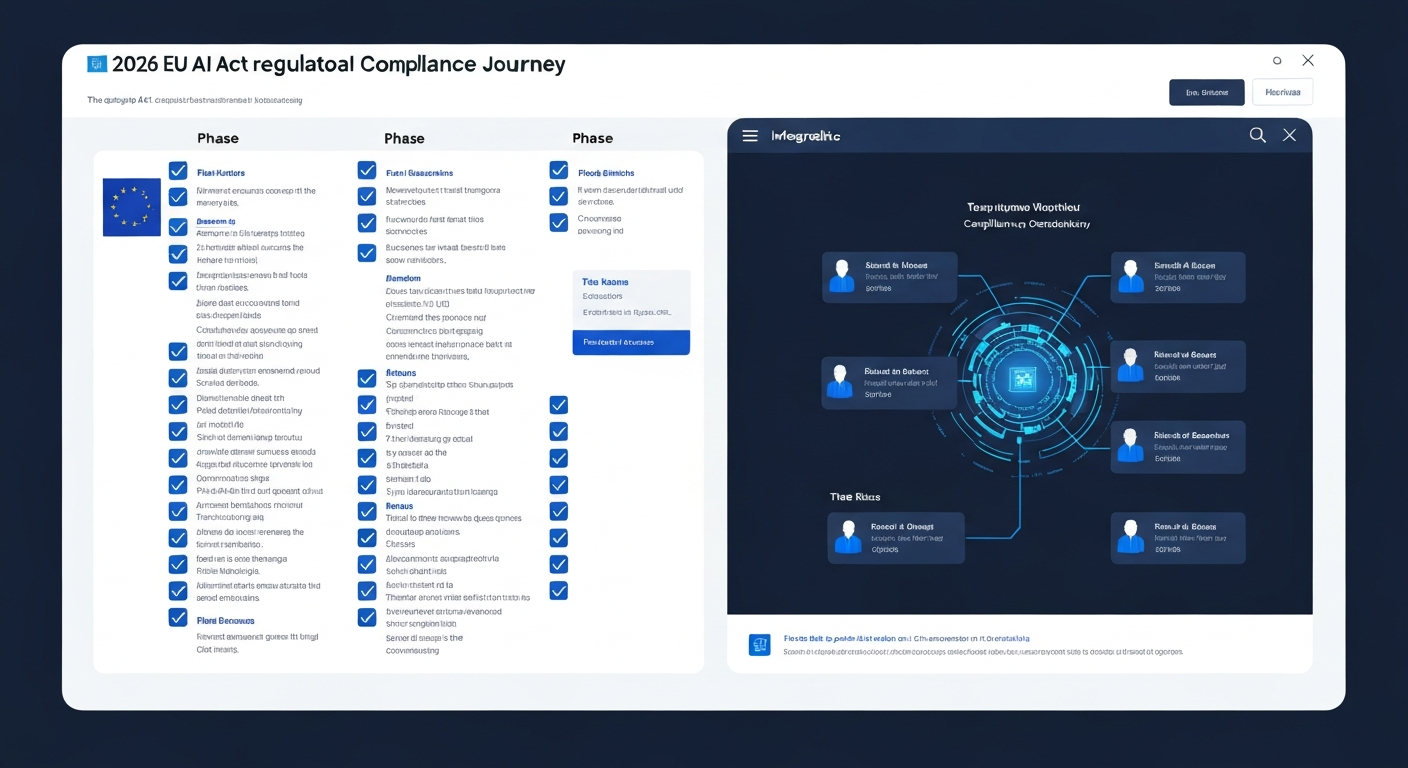
This is the fifth and final post in our EU AI Act Regulatory Sandbox series. We have covered sandbox fundamentals (Art.57), the application and development plan process (Art.58), testing protocols and evidence generation for Annex IV, and personal data access and IP protection under Art.58/59. This post synthesizes all of it into a single actionable checklist — 30 items, organized by sandbox phase, that developers building high-risk AI systems need to complete before and during regulatory sandbox participation.
August 2, 2026 is the date the EU AI Act's general obligations apply. For high-risk AI providers who cannot yet meet full compliance requirements, a regulatory sandbox is the most defensible path to continued development. But the sandbox is not a bypass — it is a supervised compliance pathway. The checklist below reflects that distinction.
Phase 1: Pre-Application (Before You Apply)
These items determine whether your system qualifies for sandbox access and whether your application will be approved by the national competent authority (NCA).
1. Confirm you are building a "high-risk AI system" under Annex III
Regulatory sandboxes under Art.57 are primarily designed for providers of high-risk AI systems — those listed in Annex III (biometric identification, critical infrastructure, employment, education, access to essential services, law enforcement, migration, administration of justice, and democratic processes). If your system does not fall under Annex III, you may still apply for a sandbox if you have a "general purpose AI model with systemic risk," but the justification requirements are different. Check whether your system genuinely qualifies before investing in the application process.
2. Verify SME or startup status for Art.62 priority access
Article 62 creates a two-tier priority system. SMEs (fewer than 250 employees, annual turnover under €50M or balance sheet under €43M) and startups (incorporated less than seven years, in early growth phase) receive priority placement in sandbox queues, simplified documentation requirements, and access to dedicated technical guidance from the supervising authority. Document your eligibility with a corporate structure summary, employee count, and latest financial statements. This evidence belongs in your sandbox application.
3. Identify which national competent authority to apply to
Sandbox access is granted by national competent authorities, not the EU AI Office. If you operate in multiple member states, you apply to the NCA of your EU establishment. If you are incorporated outside the EU but have an EU representative, the NCA of the representative's member state applies. Confirm the correct NCA before preparing any documentation — different NCAs have different application forms, timeline expectations, and sectoral expertise.
4. Check whether your member state's sandbox is operational
Article 57 requires member states to establish AI regulatory sandboxes by August 2, 2026. As of this writing, several member states (including Spain, the Netherlands, and Finland) have established operational sandbox programs; others are still in setup phase. Verify your NCA's sandbox is accepting applications before preparing documentation. A delay in sandbox availability does not extend your compliance deadline — plan accordingly.
5. Assess whether a full-compliance path is faster
For some systems, particularly those already partially compliant with Art.9 risk management and Art.17 QMS requirements, a sandbox application may not be the fastest path. The sandbox is most valuable for systems that are at least 12–18 months from full compliance under normal development timelines. If you can reach Annex IV technical documentation completeness in four to six months, the direct compliance path may be less operationally complex than a sandbox application, approval, and supervised development cycle.
Phase 2: Application Preparation
6. Draft a sandbox development plan with concrete milestones
Article 58, which covers the detailed arrangements for AI regulatory sandbox operations, requires a formal sandbox plan that the NCA will review before granting access. The plan must include: the specific AI system under development, the compliance objectives you aim to achieve through sandbox testing, the testing methodology, the timeline and milestones for achieving compliance, and the resources you will commit to the supervised development process. Vague plans are rejected. NCAs are evaluating whether your sandbox participation will actually produce compliance evidence — not whether your product is interesting.
7. Document current compliance gaps against the full AI Act requirements
Your application should include an honest gap analysis. Identify which specific Art.9 risk management controls are not yet implemented, which Art.10 training data documentation requirements are incomplete, which Art.11 technical documentation (Annex IV) items are missing, which Art.17 QMS processes are not yet operational, and which Art.72 post-market monitoring systems are not in place. Regulators respect honesty about gaps; applications that claim near-full compliance while seeking sandbox access are treated with skepticism.
8. Prepare a data management plan covering Art.58/59 requirements
If your sandbox testing will involve personal data — particularly for training, validation, or model testing — you must address Art.58 (which permits limited personal data processing in sandboxes under specific conditions) and Art.59 (which allows further processing of data originally collected for other purposes, subject to safeguards). Your application should describe: what personal data you plan to use, the lawful basis for processing in the sandbox context, pseudonymisation and access controls, data retention limits, and obligations for data deletion when sandbox participation ends.
9. Document intellectual property protection measures
Regulatory sandbox participation requires sharing model documentation, testing methodologies, and sometimes intermediate model weights with the NCA or external assessors. Before entering the sandbox, document which elements of your AI system constitute trade secrets under the EU Trade Secrets Directive (2016/943), establish confidentiality agreements with the NCA at the application stage, and define access control protocols for NCA inspectors. This is not adversarial — NCAs are legally bound to confidentiality obligations — but a documented IP management plan prevents disputes about what was shared and under what conditions.
10. Identify your primary NCA contact and escalation path
Regulatory sandbox supervision is a collaborative relationship, not a series of compliance checkpoints. Identify a dedicated technical relationship manager within the NCA (most sandbox programs have designated points of contact), establish a communication protocol for regular reporting, and define escalation criteria — what events trigger unscheduled NCA notification. Document this in your development plan.
Phase 3: Infrastructure Decisions (Before You Build Inside the Sandbox)
11. Choose EU-sovereign infrastructure for all sandbox data
This is the decision most developers underestimate. Your regulatory sandbox participation produces testing data, model versions, audit logs, incident reports, and risk assessment documentation that constitutes your Annex IV technical documentation package. If that data is stored on infrastructure subject to the US CLOUD Act (AWS, Azure, GCP — regardless of EU region), it is theoretically accessible to US government agencies without EU legal process. NCAs conducting conformity assessment review your documentation and will ask where your records are stored. "AWS eu-central-1" answers the geography question but not the jurisdiction question.
For sandbox development, choose infrastructure where data sovereignty is clean: Hetzner, Scaleway, OVHcloud, or a managed platform built on EU-jurisdiction providers. The compliance artifacts you generate in the sandbox become the foundation of your post-sandbox technical documentation. Start them in the right jurisdiction.
12. Implement structured logging for all model decisions
Article 9(7) requires that testing results — including adverse outcomes — be documented and retained as part of the risk management system. Inside the sandbox, implement structured logging that captures: input data characteristics (pseudonymised), decision outputs, confidence scores, flagged edge cases, and any system modifications made in response to testing results. This logging infrastructure must be in place before testing begins — retroactive reconstruction of testing history is not accepted as Annex IV evidence.
13. Set up version control for model artifacts with audit trail
Your Annex IV technical documentation must include "a description of any changes made to the AI system throughout its lifecycle." In sandbox testing, models change frequently. Implement a version control system for model weights, training data versions, hyperparameter configurations, and evaluation metrics — with timestamps, change authors, and change rationale. This is the audit trail that confirms your risk management process is operational, not hypothetical.
14. Establish a vulnerability disclosure process before testing begins
Article 9 risk management includes identifying and documenting potential risks from the AI system. Inside the sandbox, you will discover risks — that is the point. Establish a structured process for documenting discovered risks, the mitigation measures implemented, the residual risk level after mitigation, and the decision rationale for accepting or deferring each risk. This documentation flows directly into your risk management system (Art.9) and technical documentation (Annex IV).
Phase 4: Testing Inside the Sandbox
15. Generate evidence against each Annex IV requirement
Annex IV specifies the minimum content of technical documentation for high-risk AI systems. Not all items can be fully satisfied during sandbox testing — some require production operation — but the goal is to generate evidence covering as many Annex IV items as possible. Use our previous guide on sandbox testing protocols to map each test you run to the specific Annex IV requirement it addresses. Every test without a documented Annex IV mapping is activity, not compliance evidence.
16. Conduct adversarial testing for your specific risk category
Article 9 requires that the risk management process address the risks "foreseen and those that may be reasonably foreseeable." For Annex III systems, this means sector-specific adversarial testing. An employment-decision AI must be tested for demographic bias across protected characteristics. A biometric identification system must be tested against spoofing attacks. A medical device AI must include edge case clinical scenarios. Document not only the tests you ran but the test design rationale — why these specific adversarial scenarios are relevant to your system's risk profile.
17. Validate against the demographic distribution of your target deployment context
One of the most common reasons regulatory sandbox evidence is challenged post-sandbox is that testing was performed on an unrepresentative sample. If your system will operate across the EU, your testing dataset should include representative proportions of the demographic characteristics relevant to your system's decisions. Document the demographic composition of your testing population, the rationale for composition choices, and any limitations acknowledged by the testing design.
18. Run at minimum 90-day observation period for production-like signals
NCAs conducting post-sandbox conformity assessment will evaluate whether your testing period was long enough to generate statistically meaningful observations. A 90-day sandbox period with continuous model monitoring is generally accepted as producing valid post-market monitoring signals. If your sandbox period is shorter, the NCA may require extended testing or additional real-world validation data before issuing a conformity assessment opinion. Plan for this in your development timeline.
19. Document all incidents, including near-misses
Article 73 requires that providers of high-risk AI systems report serious incidents to the market surveillance authority. Inside the sandbox, the reporting obligation is modified — you report to the supervising NCA rather than the market surveillance authority, and the thresholds may be adjusted by the sandbox plan. But the documentation obligation is not modified: every incident, near-miss, and unexpected outcome must be logged with timing, severity, root cause analysis, and remediation action. This documentation is part of your Annex IV package and will be reviewed by assessors.
20. Produce a sandbox exit report covering all Art.9 risk management activities
Article 58 (detailed sandbox arrangements) requires that sandbox participation conclude with a report to the NCA summarizing the testing activities, compliance gaps addressed, residual risks identified, and any regulatory findings. This report is not just a compliance formality — it becomes a reference document for your post-sandbox conformity assessment. Structure the report to address each Art.9 risk management component, each Annex IV section, and each compliance gap identified in your original application.
Phase 5: Personal Data Handling
21. Apply pseudonymisation before data enters sandbox environment
Art.58 permits personal data processing in regulatory sandboxes under specific safeguards. One of the core safeguards is pseudonymisation — replacing direct identifiers with technical identifiers that cannot be reverse-attributed without additional information held separately. Implement pseudonymisation at the data ingestion layer, before data is processed by any model. Maintain a mapping table between pseudonyms and identifiers in a separately access-controlled system, with strict audit logging of who has accessed the mapping table and when.
22. Document the Art.59 further processing justification
If you are using data originally collected for a different purpose — for example, healthcare records collected for patient treatment being used to train a medical AI — you are relying on Art.59's further processing permission. This permission is not automatic. Document: the original collection purpose, the compatibility assessment showing that sandbox AI training is not incompatible with the original purpose, the specific safeguards applied (pseudonymisation, access controls, retention limits), and the legal basis. This documentation must be in place before processing begins, not after.
23. Implement data minimisation at every processing layer
The GDPR principle of data minimisation applies inside the sandbox regardless of the Art.58/59 provisions. Use only the data fields that are genuinely necessary for the specific training or testing objective. Document the minimisation decisions — which fields were excluded and why. NCAs reviewing sandbox operations have GDPR oversight authority alongside AI Act oversight authority; a sandbox operation that demonstrates visible data minimisation reduces the risk of parallel GDPR enforcement action.
24. Schedule data deletion for sandbox exit
Art.58 and Art.59 sandbox permissions are time-limited — they apply during the approved sandbox period. When sandbox participation ends, data accessed under those provisions must be deleted unless you have a separate legal basis for continued retention. Build data deletion into your exit plan: which data will be deleted, when, and how deletion will be documented. Failure to implement exit deletion is one of the most common post-sandbox NCA findings.
Phase 6: Post-Sandbox and Infrastructure Readiness
25. Map sandbox compliance artifacts to post-sandbox QMS (Art.17)
Your sandbox testing produces compliance artifacts — risk assessments, test logs, incident reports, Annex IV evidence. These artifacts need to be integrated into a quality management system that can sustain them in production. Before exiting the sandbox, map each artifact to the Art.17 QMS component it supports: document control system, risk management process, testing and validation procedures, incident management, and change management. The QMS structure you build in the sandbox becomes the QMS you maintain in production.
26. Conduct a post-market monitoring readiness assessment
Article 72 requires providers of high-risk AI systems to have a post-market monitoring system in place before the system is placed on the market or put into service. The monitoring system must include the technical means to collect and analyze data about the system's performance in production. Before sandbox exit, assess what monitoring infrastructure you have built, what additional infrastructure is needed for production deployment, and how you will collect the statistical performance data that Art.72 requires. This assessment belongs in your sandbox exit report.
27. Confirm conformity assessment path (Art.43/44)
High-risk AI systems generally require conformity assessment before being placed on the market. For most Annex III systems, self-assessment (internal review against harmonised standards) is permitted. For specific categories — biometric identification, critical infrastructure in some member states — third-party assessment by a notified body (NB) is required. Your sandbox exit plan should confirm which conformity assessment path applies to your system and what additional documentation an NB would require beyond the sandbox evidence you have generated.
28. Maintain all EU AI Act records on EU-sovereign infrastructure
Post-sandbox, the records you generated — technical documentation, risk management records, testing logs, incident reports — must be retained for the full period required by Art.72 and related provisions (generally 10 years for high-risk systems or the useful life of the system, whichever is longer). Maintain these records on EU-sovereign infrastructure where you retain full legal control. Storing compliance records on US-parented cloud infrastructure creates a structural risk: US government access to compliance documentation under the CLOUD Act would need to be disclosed in any conformity assessment review.
29. Register in the EU AI Act database (Art.71) before market placement
High-risk AI systems must be registered in the EU database established under Art.71 (operated by the AI Office) before the system is placed on the EU market. The registration requires information from your technical documentation including the system description, intended purpose, risk category, and deployer information. Prepare your Art.71 registration documentation as part of your sandbox exit process — do not treat registration as a post-launch activity.
30. Establish post-sandbox NCA relationship for ongoing supervision
Your sandbox supervisory relationship with the NCA does not end when sandbox participation ends — it evolves. High-risk AI providers are subject to ongoing market surveillance under Art.74. Establish a post-sandbox relationship with your supervising NCA that includes: annual technical documentation review contact, a protocol for communicating material system changes, and a named contact for serious incident reporting. This relationship is an asset, not a compliance burden. NCAs who supervised your sandbox development have context about your system that reduces the friction of ongoing market surveillance interactions.
Checklist Summary
| Phase | Items | Key Risk if Skipped |
|---|---|---|
| Pre-Application | 1–5 | Wasted development on ineligible system or wrong NCA |
| Application | 6–10 | Rejected application, no sandbox access |
| Infrastructure | 11–14 | Compliance artifacts in wrong jurisdiction, audit trail gaps |
| Testing | 15–20 | Sandbox evidence insufficient for conformity assessment |
| Personal Data | 21–24 | GDPR enforcement post-sandbox, NCA data audit findings |
| Post-Sandbox | 25–30 | Art.43 conformity assessment fails, Art.71 registration delay |
Infrastructure: The Decision That Persists Beyond the Sandbox
Every item in this checklist has a point at which infrastructure jurisdiction matters. Testing logs, risk management records, incident reports, training data — all of these are generated inside the sandbox and must be retained outside it. Where you store them determines who controls them.
For developers choosing sandbox infrastructure, the practical question is: after this sandbox period ends, when a notified body or market surveillance authority reviews my Annex IV documentation package, will I be able to demonstrate that this documentation was under EU legal control throughout its lifecycle?
EU-native managed PaaS platforms — where the provider has no US parent, operates on Hetzner or equivalent EU jurisdiction infrastructure, and is not subject to CLOUD Act reach — give you a clean answer. US-parented cloud platforms give you a complicated answer that requires legal opinion letters and risk acceptance documentation.
The sandbox is where you build the compliance foundation. Build it on infrastructure that will not require you to rebuild it.
Series Summary
This five-post series has covered the EU AI Act regulatory sandbox from every angle relevant to a developer building high-risk AI:
- Art.57 sandbox fundamentals and eligibility
- Application process and NCA development plan review
- Testing protocol and Annex IV evidence generation
- Personal data access, Art.58/59, and IP protection
The regulatory sandbox is the most practical compliance pathway for startups and SMEs who cannot meet full EU AI Act obligations by August 2, 2026. Use it with intent. The 30-item checklist above is your map.
EU-Native Hosting
Ready to move to EU-sovereign infrastructure?
sota.io is a German-hosted PaaS — no CLOUD Act exposure, no US jurisdiction, full GDPR compliance by design. Deploy your first app in minutes.