CLOUD Act-Resistant EU AI Act Compliance Architecture: 30-Step Developer Checklist (2026)
Post #1591 in the sota.io EU Cyber Compliance Series — EU AI Act CLOUD Act Compliance Gap #5/5 (Finale)
This is the final post in our five-part series on the hidden compliance gap between EU AI Act obligations and US CLOUD Act exposure:
- Part 1: How CLOUD Act undermines Art.9 Risk Management and Art.10 Data Governance
- Part 2: Art.12 record-keeping integrity and Art.13 transparency obligations
- Part 3: Art.26/27 deployer documentation and FRIA exposure
- Part 4: Art.43/44 conformity assessment and what NB auditors catch
The August 2026 deadline is 55 days away. This finale gives you the architectural pattern to close every exposure point and the 30-step checklist to verify you've done it.
The Core Problem, Restated
The US CLOUD Act (18 U.S.C. §2703) gives US law enforcement the authority to compel US-headquartered cloud providers to produce data regardless of where that data physically sits. AWS (Amazon, US), Azure (Microsoft, US), GCP (Google, US), and their subsidiaries all fall under this jurisdiction.
Under the EU AI Act, high-risk AI developers and deployers must:
- Maintain technical documentation that cannot be selectively disclosed or altered (Art.11, Annex IV)
- Keep logs of system operation for periods up to three years (Art.12)
- Provide transparent documentation to deployers and downstream users (Art.13)
- Implement risk management systems with documented evidence (Art.9)
- Maintain data governance documentation including training data provenance (Art.10)
- Complete a conformity assessment with a notified body that reviews this evidence (Art.43)
When this documentation lives in AWS S3, Azure Blob, or GCP Cloud Storage under a US-parented account, a CLOUD Act request can compel that provider to hand it over—potentially including selective delivery that breaks the audit chain, or disclosure that reveals your AI system's operational details to US authorities without your knowledge.
Notified bodies auditing for conformity assessment are now trained to look for this gap. Market surveillance authorities can flag it. The gap is not theoretical.
The Architecture Solution: EU-Native AI Compliance Stack
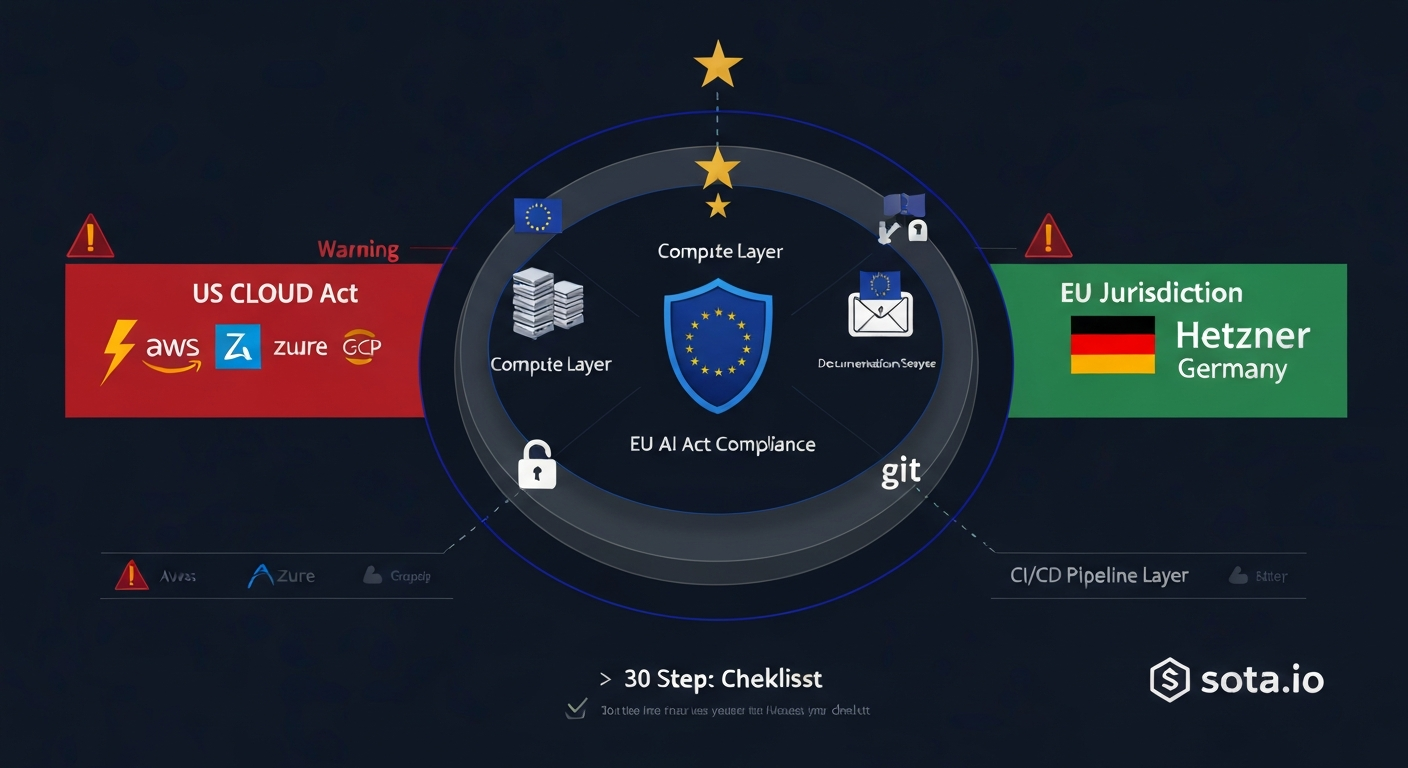
A CLOUD Act-resistant compliance architecture has four layers.
Layer 1: Compute and Inference
Where your AI models run matters less than where documentation lives. You can use inference APIs from US providers for speed and capability—but you need EU-controlled logging and evidence capture at the application layer.
Pattern: Route all inference calls through an EU-native application server that logs inputs, outputs, confidence scores, and decision rationales to EU-controlled storage before returning results to end users. The US provider never sees your compliance evidence—they only process the model calls.
Layer 2: Compliance Documentation Storage
All documents required under Art.11 and Annex IV technical documentation must live in EU-jurisdiction storage:
- Technical documentation (Annex IV items 1-9)
- Risk management system documentation (Art.9)
- Data governance documentation (Art.10)
- Logs of system operation (Art.12)
- Post-market monitoring reports (Art.72)
- Incident reports (Art.73)
- FRIA records (Art.27 for deployers)
Recommended storage: EU-native object storage with EU-headquartered provider. Hetzner Object Storage, Exoscale, Scaleway, OVHcloud, or eu.org all satisfy this requirement. None are CLOUD Act-reachable.
Layer 3: Identity and Access Management
Access to compliance documentation must be controlled via EU-jurisdiction identity systems. A US-parented IAM provider (AWS IAM, Azure AD, Google Cloud Identity) creates a secondary CLOUD Act surface: US authorities can compel access to the IAM system, which controls access to your "EU-stored" documents.
Pattern: Use EU-native identity (Keycloak on EU infrastructure, or an EU-headquartered IAM service) for all compliance documentation access. Credentials for compliance storage should not pass through US-parented authentication services.
Layer 4: CI/CD and Deployment Pipeline
For high-risk AI systems, the deployment pipeline is part of the audit trail. Commits that modify model parameters, training data pipelines, or system logic are evidence of changes that affect conformity. If your CI/CD runs on GitHub Actions (Microsoft, US) or GitLab.com's US infrastructure, that audit trail is CLOUD Act-reachable.
Pattern: Self-hosted GitLab on EU infrastructure, or Gitea/Forgejo. Deployment pipelines should log artifact digests, commit hashes, and deployment metadata to EU-native compliance storage as part of each deployment step.
30-Step CLOUD Act-Resistant EU AI Act Developer Checklist
This checklist maps to specific EU AI Act articles. Work through it before August 2026.
Phase 1: Architecture Assessment (Steps 1-8)
Step 1 — Identify every cloud provider account your AI system's data flows touch. List provider headquarters country. Flag any US-headquartered provider.
Step 2 — Map AI Act roles: are you a provider (placing a high-risk AI system on the market), a deployer (integrating a third-party AI model into your product), or both?
Step 3 — For each US-headquartered cloud account: classify what data flows through it. Separate compute/inference data (lower risk) from compliance documentation (higher risk).
Step 4 — Identify every location where Art.12 logs are generated and stored. Confirm each location is under EU-jurisdiction control.
Step 5 — Identify where your Annex IV technical documentation (9 items) is stored. Confirm EU-jurisdiction.
Step 6 — Identify where Art.9 risk management records are stored. Confirm EU-jurisdiction.
Step 7 — Identify where Art.10 data governance documentation (training data provenance, data quality assessments) is stored. Confirm EU-jurisdiction.
Step 8 — Identify where your CI/CD pipeline runs. Map artifact digests and deployment logs.
Phase 2: Storage Migration (Steps 9-15)
Step 9 — Choose an EU-native object storage provider (Hetzner, Scaleway, Exoscale, OVHcloud). Create a compliance documentation bucket with versioning enabled and deletion protection on.
Step 10 — Migrate all Annex IV technical documentation to EU-native storage. Document migration with checksums.
Step 11 — Configure Art.12 logging to write directly to EU-native storage. Verify no intermediate buffer in US-parented storage.
Step 12 — Migrate Art.9 risk management records to EU-native storage. Implement write-once retention policy matching Art.12's minimum periods.
Step 13 — Migrate Art.10 data governance documentation. Include training data version manifests, data quality assessment reports, bias evaluation records.
Step 14 — For deployers: migrate FRIA documentation (Art.27) to EU-native storage. FRIA records are particularly sensitive—they contain information about fundamental rights impact that CLOUD Act disclosure could compromise.
Step 15 — Implement backup to a second EU-native provider. Single-provider EU storage still creates a single point of failure for compliance evidence.
Phase 3: Identity and Access Hardening (Steps 16-19)
Step 16 — Audit IAM policies on all compliance storage. Remove access for any US-parented identity provider that controls credentials.
Step 17 — Deploy EU-native IAM for compliance storage access. Keycloak on EU infrastructure is the standard open-source choice. Hetzner Cloud or equivalent.
Step 18 — Rotate all compliance storage credentials. Issue new credentials via EU-native IAM only.
Step 19 — Implement audit logging on all IAM access events for compliance storage. This meta-audit trail is itself compliance evidence for Art.12.
Phase 4: CI/CD and Deployment Audit Trail (Steps 20-23)
Step 20 — Assess whether your CI/CD pipeline constitutes part of your AI system change audit trail. If yes (it does for most high-risk systems), plan migration.
Step 21 — Deploy self-hosted Gitea or GitLab CE on EU infrastructure. Migrate AI system repository.
Step 22 — Configure deployment pipelines to write artifact digests and deployment events to EU-native compliance storage.
Step 23 — Document deployment pipeline architecture in Annex IV technical documentation. Notified bodies expect to see how you control changes to the system.
Phase 5: Conformity Assessment Preparation (Steps 24-27)
Step 24 — Compile complete Annex IV technical documentation set. Verify all 9 items are present and stored in EU-native storage.
Step 25 — Conduct a pre-audit walkthrough: can you produce any document a notified body requests without touching US-parented storage? Test this explicitly.
Step 26 — Prepare a CLOUD Act exposure statement for your notified body. This is increasingly required: NBs want to see that you have assessed and mitigated CLOUD Act risk.
Step 27 — If your system uses a third-party AI model (you are a deployer), prepare the Art.26 documentation package: technical measures implemented, human oversight mechanisms, evidence of fundamental rights assessment.
Phase 6: Operational Readiness (Steps 28-30)
Step 28 — Configure Art.73 incident reporting pipeline to route through EU infrastructure. Serious incident notifications to market surveillance authorities cannot pass through CLOUD Act-reachable logging infrastructure.
Step 29 — Configure Art.72 post-market monitoring to store monitoring results in EU-native storage. PMM data is long-retention (minimum 10 years for some categories) and a primary target for evidence requests.
Step 30 — Conduct a final CLOUD Act gap assessment. For each item in your Annex IV documentation: confirm EU-jurisdiction storage, confirm EU-jurisdiction IAM, confirm no US-parented intermediary in the evidence chain. Document the assessment as a standalone compliance artifact.
The sota.io Architecture Reference
sota.io is an EU-native managed PaaS on Hetzner Germany. For developers building CLOUD Act-resistant EU AI Act compliance infrastructure, it provides:
- EU-jurisdiction compute: Hetzner Germany, no US parent, no CLOUD Act exposure
- Git-deploy: any language and framework, including compliance automation toolchains
- EU-native object storage integration: connect to Hetzner Object Storage, Exoscale, Scaleway
- EU-native IAM support: deploy Keycloak or equivalent on the same EU infrastructure
A typical compliance stack on sota.io: application server (handling inference routing and log capture), PostgreSQL (structured compliance event log), Hetzner Object Storage (document archive), Keycloak (IAM). All under German jurisdiction. None CLOUD Act-reachable.
Timeline: 55 Days to August 2026
| Deadline | Obligation |
|---|---|
| August 2, 2026 | EU AI Act full application for high-risk AI systems under Annex III |
| June 11, 2026 | CRA Notified Bodies go live — NB ecosystem fully operational |
| Now | Architecture assessment and migration planning |
The 30-step checklist above is calibrated to complete in 4-6 weeks with a focused engineering sprint. Starting now puts you at completion by mid-July — two weeks before the August deadline.
Key Takeaways
-
CLOUD Act exposure is architectural, not contractual. Standard Contractual Clauses and Data Processing Agreements do not protect against CLOUD Act orders. Only EU-jurisdiction infrastructure does.
-
The gap is in documentation, not inference. You can continue using US AI APIs for model inference while moving compliance evidence architecture to EU jurisdiction.
-
Notified bodies are now explicitly checking. The NB ecosystem activated in June 2026 has CLOUD Act gap assessment in their audit protocols. This is not a future risk—it is a current audit criterion.
-
The 30-step checklist is sequenced for minimum migration overhead. Storage migration (Steps 9-15) delivers the most risk reduction. Do it first.
-
sota.io provides the reference architecture. EU-native managed PaaS, Hetzner Germany, no CLOUD Act exposure, connects to EU-native storage. Start free.
This concludes the EU AI Act + CLOUD Act Compliance Gap series. For the full five-part series: Part 1 · Part 2 · Part 3 · Part 4
EU-Native Hosting
Ready to move to EU-sovereign infrastructure?
sota.io is a German-hosted PaaS — no CLOUD Act exposure, no US jurisdiction, full GDPR compliance by design. Deploy your first app in minutes.