EU AI Act Art.72 PMS: Bias Monitoring in Production — Fairness Metrics & Demographic Performance Tracking for High-Risk AI
Post #1609 in the sota.io EU AI Act Post-Market Monitoring Operations Series
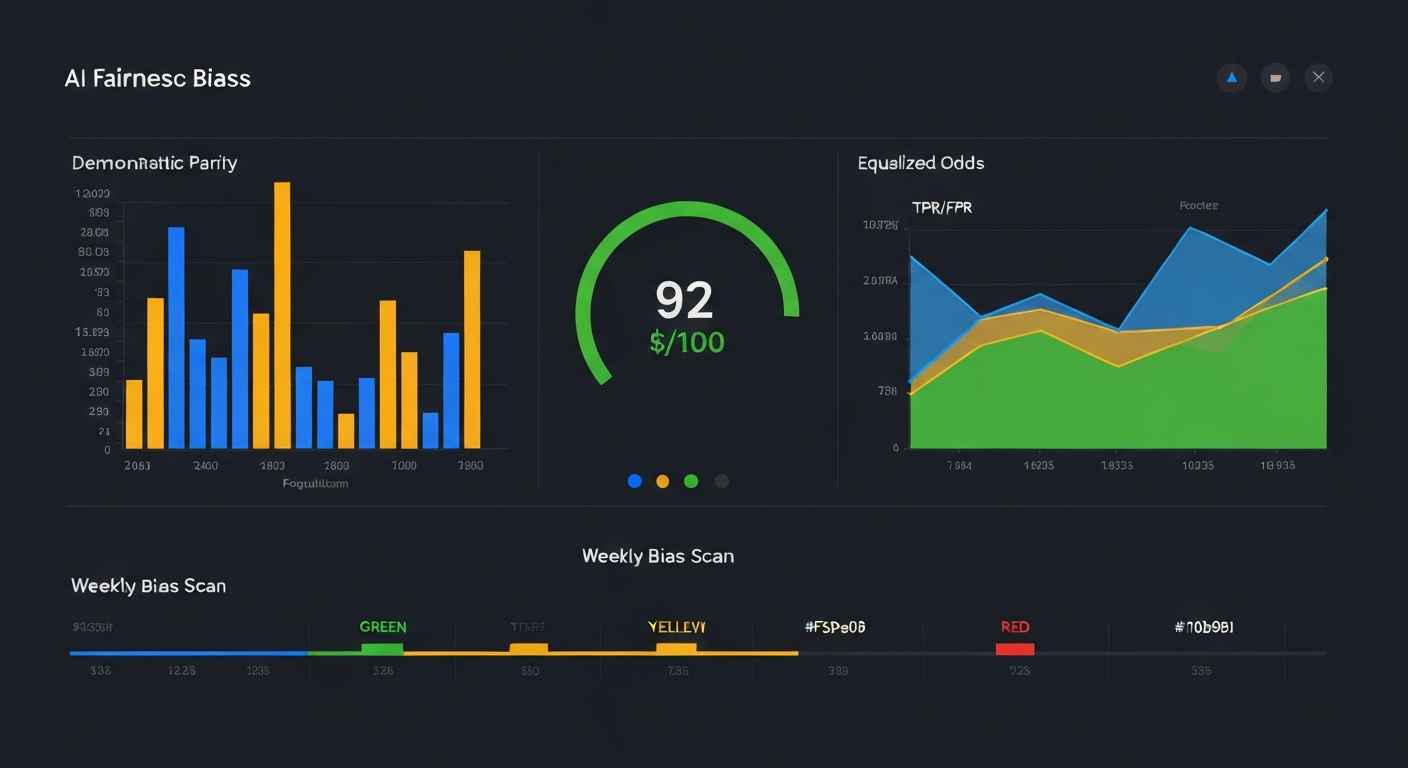
Your high-risk AI system passed conformity assessment. Your technical documentation is complete. But once you deploy to production, a new compliance clock starts — and bias monitoring is one of the most legally consequential things your Art.72 post-market monitoring system must track.
This post covers how to build production bias monitoring that satisfies EU AI Act obligations: which metrics to track, how to collect demographic performance data without violating GDPR, what bias thresholds trigger action, and when production bias escalates from "monitoring finding" to Art.73 serious incident.
Why Art.72 Requires Bias Monitoring
Article 72 of the EU AI Act mandates that providers of high-risk AI systems implement a post-market monitoring (PMS) system that tracks real-world performance throughout the system's operational lifetime. This isn't a voluntary best practice — it's a legal obligation with enforcement teeth.
For bias monitoring specifically, three intersecting obligations drive the requirement:
Art.9(2)(a) — Your risk management system must identify risks of harm to persons or groups of persons, explicitly including discriminatory outcomes. A bias monitoring system is how you prove you're managing these risks in production, not just at deployment.
Art.10(2)(f) — Data governance requirements state that training, validation, and testing datasets must be "relevant, representative, free of errors and complete" and must "have the appropriate statistical properties" for the populations on which the system will be used. If your production population drifts from your training population, your Art.10 compliance drifts too — and only monitoring catches this.
Art.72(3) — The PMS plan must specify what data will be collected and what performance indicators are tracked. For high-risk AI in domains like HR, credit scoring, education, or essential services, demographic performance indicators are non-negotiable PMS components.
The consequence of not monitoring: if your system develops discriminatory behavior post-deployment and you can't demonstrate you were monitoring for it, you face enforcement action under both the EU AI Act and applicable national anti-discrimination law.
The EU Legal Definition of Prohibited Discrimination
Before choosing fairness metrics, understand what EU law treats as prohibited discrimination. Article 21 of the EU Charter of Fundamental Rights prohibits discrimination based on:
- Sex
- Race
- Colour
- Ethnic or social origin
- Genetic features
- Language
- Religion or belief
- Political or other opinion
- Membership of a national minority
- Property
- Birth
- Disability
- Age
- Sexual orientation
Your bias monitoring must cover the characteristics relevant to your system's domain and deployment context. A credit scoring AI must monitor for sex and ethnic origin. An HR screening tool must monitor for age, sex, and disability. A healthcare triage AI must monitor for all of the above.
Fairness Metrics: What to Track
There is no single "correct" fairness metric — different metrics encode different normative choices. But EU AI Act enforcement will expect you to have reasoned choices documented in your risk management system.
Metric 1: Demographic Parity (Statistical Parity)
Measures whether your model produces positive outcomes at equal rates across demographic groups.
import pandas as pd
import numpy as np
from typing import Dict, Tuple

class DemographicParityMonitor:
    """
    Monitors demographic parity: P(Y_hat=1 | A=a) = P(Y_hat=1 | A=b)

    EU AI Act context: required for Art.9 risk tracking when AI makes
    binary decisions affecting different population groups.
    """

    def __init__(self, threshold: float = 0.05):
        self.threshold = threshold  # max allowed parity gap

    def compute(
        self,
        predictions: pd.Series,
        sensitive_attr: pd.Series,
        label: str = "group"
    ) -> Dict:
        results = {}
        groups = sensitive_attr.unique()

        base_rate = predictions.mean()

        for group in groups:
            mask = sensitive_attr == group
            group_rate = predictions[mask].mean()
            parity_gap = abs(group_rate - base_rate)

            results[str(group)] = {
                "positive_rate": round(float(group_rate), 4),
                "parity_gap": round(float(parity_gap), 4),
                "n_samples": int(mask.sum()),
                "alert": parity_gap > self.threshold,
                "alert_level": self._classify_gap(parity_gap)
            }

        return {
            "metric": "demographic_parity",
            "overall_rate": round(float(base_rate), 4),
            "groups": results,
            "max_gap": round(float(max(r["parity_gap"] for r in results.values())), 4),
            "compliant": all(not r["alert"] for r in results.values())
        }

    def _classify_gap(self, gap: float) -> str:
        if gap < 0.05:
            return "GREEN"
        elif gap < 0.10:
            return "YELLOW"  # internal review trigger
        elif gap < 0.20:
            return "ORANGE"  # Art.73 assessment required
        else:
            return "RED"     # potential Art.73 serious incident
Metric 2: Equalized Odds
Measures whether true positive rate AND false positive rate are equal across groups. More demanding than demographic parity — appropriate for high-stakes decisions.
from sklearn.metrics import confusion_matrix

class EqualizedOddsMonitor:
    """
    Equalized odds: TPR and FPR equal across groups.

    Critical for: HR tools (equal interview rate), credit scoring (equal approval
    for qualified applicants), healthcare (equal diagnosis rate).
    """

    def compute(
        self,
        y_true: pd.Series,
        y_pred: pd.Series,
        sensitive_attr: pd.Series,
        min_group_size: int = 50
    ) -> Dict:
        results = {}
        groups = sensitive_attr.unique()

        for group in groups:
            mask = sensitive_attr == group
            if mask.sum() < min_group_size:
                results[str(group)] = {
                    "status": "INSUFFICIENT_DATA",
                    "n_samples": int(mask.sum()),
                    "min_required": min_group_size
                }
                continue

            y_t = y_true[mask]
            y_p = y_pred[mask]

            # Handle groups with no positive labels
            if y_t.sum() == 0:
                results[str(group)] = {
                    "status": "NO_POSITIVE_LABELS",
                    "n_samples": int(mask.sum())
                }
                continue

            tn, fp, fn, tp = confusion_matrix(y_t, y_p, labels=[0, 1]).ravel()

            tpr = tp / (tp + fn) if (tp + fn) > 0 else 0.0
            fpr = fp / (fp + tn) if (fp + tn) > 0 else 0.0

            results[str(group)] = {
                "true_positive_rate": round(float(tpr), 4),
                "false_positive_rate": round(float(fpr), 4),
                "n_samples": int(mask.sum()),
                "n_positive": int(tp + fn)
            }

        # Compute max disparities across groups with sufficient data
        valid = {k: v for k, v in results.items()
                 if "true_positive_rate" in v}

        if len(valid) >= 2:
            tpr_values = [v["true_positive_rate"] for v in valid.values()]
            fpr_values = [v["false_positive_rate"] for v in valid.values()]
            tpr_disparity = max(tpr_values) - min(tpr_values)
            fpr_disparity = max(fpr_values) - min(fpr_values)
        else:
            tpr_disparity = None
            fpr_disparity = None

        return {
            "metric": "equalized_odds",
            "groups": results,
            "tpr_disparity": round(float(tpr_disparity), 4) if tpr_disparity else None,
            "fpr_disparity": round(float(fpr_disparity), 4) if fpr_disparity else None,
            "compliant": (tpr_disparity is not None and
                         tpr_disparity < 0.10 and
                         fpr_disparity < 0.10)
        }
Metric 3: Calibration by Group
For probabilistic outputs (risk scores, confidence scores), calibration ensures that a 70% predicted probability actually corresponds to a 70% outcome rate — across all demographic groups.
from sklearn.calibration import calibration_curve

class GroupCalibrationMonitor:
    """
    Checks that predicted probabilities are calibrated equally across groups.

    EU AI Act context: Art.13 transparency requires that users understand
    the system's limitations. Miscalibrated scores for specific groups
    violates the transparency principle.
    """

    def compute(
        self,
        y_true: pd.Series,
        y_prob: pd.Series,
        sensitive_attr: pd.Series,
        n_bins: int = 10
    ) -> Dict:
        results = {}

        for group in sensitive_attr.unique():
            mask = sensitive_attr == group
            if mask.sum() < 100:  # need sufficient samples for calibration
                continue

            y_t = y_true[mask].values
            y_p = y_prob[mask].values

            try:
                fraction_of_positives, mean_predicted = calibration_curve(
                    y_t, y_p, n_bins=n_bins, strategy='uniform'
                )

                # Expected Calibration Error (ECE)
                ece = np.mean(np.abs(fraction_of_positives - mean_predicted))

                results[str(group)] = {
                    "expected_calibration_error": round(float(ece), 4),
                    "n_samples": int(mask.sum()),
                    "alert": ece > 0.10,
                    "alert_level": "RED" if ece > 0.20 else ("YELLOW" if ece > 0.10 else "GREEN")
                }
            except Exception as e:
                results[str(group)] = {
                    "error": str(e),
                    "n_samples": int(mask.sum())
                }

        return {
            "metric": "group_calibration",
            "groups": results,
            "max_ece": round(float(max(
                v["expected_calibration_error"] for v in results.values()
                if "expected_calibration_error" in v
            )), 4) if results else None,
            "compliant": all(
                not v.get("alert", False) for v in results.values()
            )
        }
Privacy-Compliant Demographic Data Collection
Here's the tension: you need demographic data to monitor for bias, but collecting sensitive attributes (race, religion, sex) in the EU is restricted under GDPR Art.9 special category data rules. How do you monitor for bias without creating a GDPR violation?
Approach 1: User-Voluntary Disclosure with Explicit Consent
For B2C systems, allow users to voluntarily disclose demographic attributes for fairness monitoring purposes, with explicit consent and clear data minimization.
class VoluntaryDemographicCollector:
    """
    Collects demographic data with explicit consent for bias monitoring.
    GDPR Art.9(2)(a) basis: explicit consent.
    """

    DISCLOSURE_TEXT = """
    We monitor our AI system for fairness. To help us ensure equal
    treatment, you may optionally share demographic information.
    This data is used only for bias monitoring, stored separately
    from your profile, and never used to make decisions about you.
    You can withdraw consent at any time.
    """

    def create_consent_record(
        self,
        user_id: str,
        disclosed_attributes: Dict,
        consent_timestamp: str
    ) -> Dict:
        # Store separately from operational data
        # Pseudonymize: link via hash, not direct user ID
        import hashlib
        pseudonym = hashlib.sha256(
            f"{user_id}:bias_monitoring_v1".encode()
        ).hexdigest()[:16]

        return {
            "pseudonym": pseudonym,
            "attributes": disclosed_attributes,
            "consent_timestamp": consent_timestamp,
            "consent_basis": "GDPR_ART9_2A_EXPLICIT",
            "processing_purpose": "EU_AI_ACT_ART72_BIAS_MONITORING",
            "retention_days": 365,
            "withdraw_endpoint": "/api/bias-monitoring/withdraw-consent"
        }
Approach 2: Proxy Attributes from Operational Data
Where direct demographic collection isn't feasible, derive proxy indicators from data that's already collected for operational purposes.
class ProxyBiasAnalyzer:
    """
    Analyzes bias using proxy attributes from operational data.

    Example: zip code → socioeconomic proxy
             name patterns → potential name-based discrimination
             writing style → potential language bias

    Limitation: proxies are imperfect. Document this limitation in your
    Art.9 risk management system and Art.12 technical documentation.
    """

    def analyze_name_based_patterns(
        self,
        predictions: pd.Series,
        names: pd.Series
    ) -> Dict:
        # Detect if model performance correlates with name origin
        # Using public name-origin classification (privacy-neutral)
        from ethnicolr import pred_wiki_name

        name_origins = names.apply(
            lambda n: self._safe_predict_origin(n)
        )

        return {
            "proxy_type": "name_origin",
            "limitation": "Proxy analysis only. Not conclusive of discrimination.",
            "positive_rates_by_origin": {
                origin: predictions[name_origins == origin].mean()
                for origin in name_origins.unique()
                if (name_origins == origin).sum() >= 20
            },
            "documentation_required": True,
            "art12_disclosure": "Bias monitoring uses name-origin proxies due to absence of direct demographic data."
        }

    def _safe_predict_origin(self, name: str) -> str:
        try:
            # Simplified - use appropriate library
            return "unknown"
        except:
            return "unknown"
Approach 3: Aggregate Cohort Analysis
For many deployments, you can monitor bias through cohort analysis without individual-level demographic data.
class CohortBiasAnalyzer:
    """
    Monitors bias through cohort-level analysis.

    Groups users by non-sensitive cohort characteristics (e.g., account age,
    geographic region, product tier) and checks for unexplained performance
    disparities that may indicate bias.

    Advantage: no special-category data collected.
    Limitation: may miss specific demographic bias patterns.
    Document this trade-off in Art.9 risk management.
    """

    def analyze_cohort_parity(
        self,
        predictions: pd.Series,
        cohort_labels: pd.Series,
        min_cohort_size: int = 100
    ) -> Dict:
        results = {}
        overall_rate = predictions.mean()

        for cohort in cohort_labels.unique():
            mask = cohort_labels == cohort
            if mask.sum() < min_cohort_size:
                continue

            cohort_rate = predictions[mask].mean()
            deviation = abs(cohort_rate - overall_rate)

            results[str(cohort)] = {
                "positive_rate": round(float(cohort_rate), 4),
                "deviation_from_overall": round(float(deviation), 4),
                "n_samples": int(mask.sum()),
                "flag": deviation > 0.15
            }

        flagged = [k for k, v in results.items() if v.get("flag")]

        return {
            "metric": "cohort_parity",
            "overall_positive_rate": round(float(overall_rate), 4),
            "cohorts": results,
            "flagged_cohorts": flagged,
            "investigation_required": len(flagged) > 0,
            "note": "Flagged cohorts require investigation for demographic correlation."
        }
Building the Production Bias Monitoring Pipeline
Combine the individual metrics into a complete bias monitoring pipeline that integrates with your Art.72 PMS:
import json
from datetime import datetime, timezone
from dataclasses import dataclass, field
from typing import Optional, List

@dataclass
class BiasMonitoringReport:
    run_id: str
    timestamp: str
    system_id: str
    monitoring_period_days: int
    n_predictions_analyzed: int
    demographic_parity: Optional[Dict] = None
    equalized_odds: Optional[Dict] = None
    calibration: Optional[Dict] = None
    cohort_analysis: Optional[Dict] = None
    overall_status: str = "GREEN"
    requires_art73_assessment: bool = False
    requires_internal_review: bool = False
    findings: List[str] = field(default_factory=list)
    recommended_actions: List[str] = field(default_factory=list)

    def to_audit_record(self) -> Dict:
        return {
            "report_id": self.run_id,
            "timestamp": self.timestamp,
            "eu_ai_act_reference": "Art.72(3) Post-Market Monitoring — Bias Analysis",
            "system_id": self.system_id,
            "monitoring_period_days": self.monitoring_period_days,
            "n_predictions": self.n_predictions_analyzed,
            "results": {
                "demographic_parity": self.demographic_parity,
                "equalized_odds": self.equalized_odds,
                "calibration": self.calibration,
                "cohort_analysis": self.cohort_analysis
            },
            "overall_status": self.overall_status,
            "requires_art73_assessment": self.requires_art73_assessment,
            "requires_internal_review": self.requires_internal_review,
            "findings": self.findings,
            "recommended_actions": self.recommended_actions
        }


class ProductionBiasMonitoringPipeline:
    """
    Complete bias monitoring pipeline for EU AI Act Art.72 compliance.

    Runs on configurable schedule, stores results in audit log,
    escalates to Art.73 pipeline when thresholds exceeded.
    """

    def __init__(
        self,
        system_id: str,
        data_store,  # your database connector
        alert_dispatcher,  # your alerting system
        audit_logger  # your audit log writer
    ):
        self.system_id = system_id
        self.data_store = data_store
        self.alert_dispatcher = alert_dispatcher
        self.audit_logger = audit_logger

        self.dp_monitor = DemographicParityMonitor(threshold=0.05)
        self.eo_monitor = EqualizedOddsMonitor()
        self.cal_monitor = GroupCalibrationMonitor()
        self.cohort_analyzer = CohortBiasAnalyzer()

    def run_weekly_bias_scan(
        self,
        window_days: int = 7
    ) -> BiasMonitoringReport:
        run_id = f"bias-scan-{datetime.now(timezone.utc).strftime('%Y%m%d-%H%M')}"
        timestamp = datetime.now(timezone.utc).isoformat()

        # Load prediction data from the last window_days
        df = self.data_store.load_predictions_window(days=window_days)

        report = BiasMonitoringReport(
            run_id=run_id,
            timestamp=timestamp,
            system_id=self.system_id,
            monitoring_period_days=window_days,
            n_predictions_analyzed=len(df)
        )

        if len(df) < 200:
            report.findings.append(
                f"Insufficient data: {len(df)} predictions in {window_days}d window. "
                f"Min 200 required for statistical validity."
            )
            report.overall_status = "DATA_INSUFFICIENT"
            self.audit_logger.write(report.to_audit_record())
            return report

        # Run available bias analyses based on data availability
        self._run_demographic_parity(df, report)
        self._run_equalized_odds(df, report)
        self._run_calibration(df, report)
        self._run_cohort_analysis(df, report)

        # Determine overall status and escalation
        self._evaluate_overall_status(report)

        # Write to audit log (Art.12 record-keeping)
        self.audit_logger.write(report.to_audit_record())

        # Escalate if needed
        if report.requires_art73_assessment:
            self.alert_dispatcher.trigger_art73_assessment(report)
        elif report.requires_internal_review:
            self.alert_dispatcher.trigger_internal_review(report)

        return report

    def _run_demographic_parity(self, df: pd.DataFrame, report: BiasMonitoringReport):
        if "sensitive_attr" not in df.columns or "prediction" not in df.columns:
            return

        result = self.dp_monitor.compute(
            df["prediction"],
            df["sensitive_attr"]
        )
        report.demographic_parity = result

        if result["max_gap"] > 0.20:
            report.findings.append(
                f"CRITICAL: Demographic parity gap {result['max_gap']:.3f} exceeds 0.20 threshold. "
                f"Art.73 assessment required."
            )
            report.requires_art73_assessment = True
        elif result["max_gap"] > 0.10:
            report.findings.append(
                f"WARNING: Demographic parity gap {result['max_gap']:.3f} exceeds 0.10. "
                f"Internal review required."
            )
            report.requires_internal_review = True

    def _run_equalized_odds(self, df: pd.DataFrame, report: BiasMonitoringReport):
        required = ["prediction", "ground_truth", "sensitive_attr"]
        if not all(c in df.columns for c in required):
            return

        result = self.eo_monitor.compute(
            df["ground_truth"],
            df["prediction"],
            df["sensitive_attr"]
        )
        report.equalized_odds = result

        if result.get("tpr_disparity", 0) and result["tpr_disparity"] > 0.20:
            report.findings.append(
                f"CRITICAL: TPR disparity {result['tpr_disparity']:.3f} across groups. "
                f"System provides unequal benefit to different demographic groups."
            )
            report.requires_art73_assessment = True

    def _run_calibration(self, df: pd.DataFrame, report: BiasMonitoringReport):
        if not all(c in df.columns for c in ["probability", "ground_truth", "sensitive_attr"]):
            return

        result = self.cal_monitor.compute(
            df["ground_truth"],
            df["probability"],
            df["sensitive_attr"]
        )
        report.calibration = result

        if result.get("max_ece", 0) and result["max_ece"] > 0.20:
            report.findings.append(
                f"WARNING: Max group calibration error {result['max_ece']:.3f}. "
                f"Predicted probabilities misleading for some groups. "
                f"Art.13 transparency disclosure may require update."
            )
            report.requires_internal_review = True

    def _run_cohort_analysis(self, df: pd.DataFrame, report: BiasMonitoringReport):
        if "cohort" not in df.columns or "prediction" not in df.columns:
            return

        result = self.cohort_analyzer.analyze_cohort_parity(
            df["prediction"],
            df["cohort"]
        )
        report.cohort_analysis = result

        if result.get("flagged_cohorts"):
            report.findings.append(
                f"INFO: {len(result['flagged_cohorts'])} cohorts show elevated deviation. "
                f"Manual review recommended for demographic correlation."
            )
            report.recommended_actions.append(
                f"Investigate cohorts: {', '.join(result['flagged_cohorts'])[:100]}"
            )

    def _evaluate_overall_status(self, report: BiasMonitoringReport):
        if report.requires_art73_assessment:
            report.overall_status = "RED"
            report.recommended_actions.insert(0,
                "IMMEDIATE: Initiate Art.73 serious incident assessment procedure."
            )
        elif report.requires_internal_review:
            report.overall_status = "YELLOW"
            report.recommended_actions.insert(0,
                "Schedule internal bias review within 5 business days."
            )
        elif report.findings:
            report.overall_status = "YELLOW"
        else:
            report.overall_status = "GREEN"
Monitoring Schedule and Thresholds
Article 72 doesn't prescribe specific monitoring intervals, but the obligation to collect "relevant data throughout the system's operational lifetime" implies ongoing, systematic monitoring. Industry practice and NCA enforcement guidance converges on:
| Monitoring Type | Frequency | Trigger for Ad-Hoc Run |
|---|---|---|
| Demographic parity scan | Weekly | Complaint received, new deployment |
| Equalized odds analysis | Bi-weekly | Ground truth data available |
| Calibration check | Monthly | Model update, data distribution shift |
| Deep-dive cohort analysis | Quarterly | Yellow or Red finding in weekly scan |
| Full bias audit | Annual | Or before substantial modification (Art.43) |
Alert Thresholds
Document these thresholds in your Art.9 risk management plan:
| Metric | Green | Yellow (Internal Review) | Orange (Assessment) | Red (Art.73) |
|---|---|---|---|---|
| Demographic parity gap | <0.05 | 0.05–0.10 | 0.10–0.20 | >0.20 |
| TPR disparity | <0.05 | 0.05–0.10 | 0.10–0.20 | >0.20 |
| FPR disparity | <0.05 | 0.05–0.10 | 0.10–0.15 | >0.15 |
| Max group ECE | <0.05 | 0.05–0.10 | — | >0.20 |
These are reasonable starting thresholds based on domain practice and the 80% rule from US/EU employment discrimination law. Adjust based on your specific system's risk level, Annex III classification, and documented in your Art.9 system.
When Bias Becomes an Art.73 Serious Incident
Article 73 requires providers to report "serious incidents" to market surveillance authorities. The EU AI Act defines a serious incident as any incident that results in — or could plausibly result in — death, serious damage to health, property, or society, or infringement of fundamental rights.
Discriminatory AI behavior can directly constitute a fundamental rights infringement under Art.73. The escalation path:
Level 1 — Internal Review (Yellow): Parity gap 0.10–0.20. Bias monitoring flagged. No confirmed discriminatory outcomes yet. Action: convene internal review team, run root cause analysis, document in Art.9 risk log.
Level 2 — Art.73 Assessment (Orange): Parity gap >0.20, OR confirmed different treatment of protected groups in consequential decisions (loan denial, job rejection, healthcare access). Action: legal and compliance review within 72 hours, assess whether fundamental rights infringement threshold is met.
Level 3 — Art.73 Notification (Red): Assessment confirms that the system's discriminatory behavior constitutes or risk-likely constitutes a fundamental rights infringement affecting a protected class. Action: notify relevant market surveillance authority (NCA) within 2 working days of confirmation.
class BiasToArt73Escalator:
    """
    Bridges bias monitoring findings to Art.73 incident assessment.

    Key principle: not every bias finding is an Art.73 serious incident.
    The escalation requires documented assessment that fundamental rights
    infringement has occurred or is likely.
    """

    ART73_ASSESSMENT_CRITERIA = [
        "Parity gap > 0.20 sustained over 2+ monitoring cycles",
        "Confirmed differential outcomes for EU Charter Art.21 protected class",
        "System used in consequential decisions (employment, credit, education, essential services)",
        "Affected population size > 100 individuals",
        "Root cause cannot be corrected without system suspension"
    ]

    def initiate_assessment(self, bias_report: BiasMonitoringReport) -> Dict:
        return {
            "assessment_id": f"art73-bias-{bias_report.run_id}",
            "initiated_at": datetime.now(timezone.utc).isoformat(),
            "trigger_report": bias_report.run_id,
            "status": "ASSESSMENT_PENDING",
            "assessment_criteria": self.ART73_ASSESSMENT_CRITERIA,
            "deadline": "2 working days from confirmation of fundamental rights infringement",
            "legal_basis": "EU AI Act Art.73(1) — serious incident reporting",
            "responsible_team": "Legal + Compliance + Product",
            "documentation_required": [
                "Bias monitoring reports for past 90 days",
                "List of affected decisions and users",
                "Root cause analysis",
                "Corrective action plan",
                "Risk management system update (Art.9)"
            ]
        }
EU-Hosting Considerations for Bias Monitoring Data
Demographic monitoring data — even pseudonymized — is special-category data under GDPR. Where this data is processed and stored matters for EU AI Act compliance:
What data does bias monitoring create?
- Aggregated fairness metrics (can be stored anywhere — not personal data)
- Individual-level prediction logs linked to demographic attributes (special-category personal data)
- Cohort analysis data (borderline — document your assessment)
EU-hosting requirement: Individual-level demographic-linked prediction logs should be stored in EU jurisdiction. US-hosted analytics platforms (even with SCCs) create Cloud Act exposure — US law enforcement can compel access to these records without EU notice. For high-risk AI systems monitoring fundamental rights compliance, this is a documented risk in your Art.9 system.
Practical architecture:
- Aggregate fairness metrics → any cloud (these are statistical summaries, not personal data)
- Individual prediction logs with demographics → EU-jurisdiction storage only
- Bias monitoring pipeline computation → can run in EU or on-premise
Data Retention for Bias Monitoring Records
Article 12 requires providers to maintain records, including PMS data, for a period that allows demonstration of conformity. Combine with GDPR data minimization:
| Data Type | Retention | Basis |
|---|---|---|
| Aggregate bias metrics | 10 years | Art.12 conformity records |
| Individual prediction logs (no demographics) | Per operational policy | Standard record-keeping |
| Individual logs with demographics | 3 years maximum | GDPR Art.9 data minimization |
| Art.73 assessment records | 10 years | Art.12 serious incident records |
| Bias monitoring reports | 10 years | Art.12 PMS documentation |
Art.27 FRIA Integration
Article 27 of the EU AI Act requires deployers of high-risk AI systems (in certain contexts) to conduct a Fundamental Rights Impact Assessment (FRIA). Your bias monitoring system produces the evidence base for the FRIA.
When updating your Art.27 FRIA (recommended annually, or after significant bias findings), pull from:
class FRIABiasEvidence:
    """
    Exports bias monitoring data in FRIA-compatible format.
    Art.27 requires evidence of bias risk assessment and mitigation.
    """

    def generate_fria_section(
        self,
        monitoring_reports: List[BiasMonitoringReport],
        period_start: str,
        period_end: str
    ) -> Dict:

        all_findings = []
        worst_parity_gaps = {}

        for report in monitoring_reports:
            all_findings.extend(report.findings)

            if report.demographic_parity:
                for group, data in report.demographic_parity.get("groups", {}).items():
                    gap = data.get("parity_gap", 0)
                    if group not in worst_parity_gaps or gap > worst_parity_gaps[group]:
                        worst_parity_gaps[group] = gap

        return {
            "fria_section": "4.3 Non-Discrimination and Equality",
            "eu_ai_act_reference": "Art.27 — Fundamental Rights Impact Assessment",
            "monitoring_period": f"{period_start} to {period_end}",
            "total_bias_scans": len(monitoring_reports),
            "worst_parity_gaps_observed": worst_parity_gaps,
            "significant_findings": [
                f for f in all_findings
                if any(kw in f for kw in ["CRITICAL", "Art.73", "fundamental rights"])
            ],
            "art73_incidents": sum(
                1 for r in monitoring_reports if r.requires_art73_assessment
            ),
            "overall_compliance_assessment": (
                "LOW RISK" if not any(r.requires_art73_assessment for r in monitoring_reports) and
                all((r.overall_status in ["GREEN", "DATA_INSUFFICIENT"]) for r in monitoring_reports)
                else "REQUIRES REVIEW"
            )
        }
Pre-August 2026 Bias Monitoring Checklist
You have until August 2, 2026 (54 days) to have your bias monitoring system operational for high-risk AI systems:
Week 1-2: Foundation
- Identify which protected attributes are relevant for your system's domain
- Audit existing data collection for demographic data availability
- Choose demographic data collection approach (voluntary, proxy, or cohort)
- Document data collection approach in Art.9 risk management system
- Implement data pseudonymization for any demographic records
Week 3-4: Metrics Implementation
- Implement demographic parity monitoring for your use case
- Implement equalized odds (if ground truth available)
- Implement calibration monitoring for probabilistic outputs
- Set and document alert thresholds in Art.9 plan
- Test bias monitoring pipeline against historical data
Week 5-6: Pipeline Integration
- Integrate bias monitoring into Art.72 PMS pipeline
- Connect to audit logging (Art.12 record-keeping)
- Implement Art.73 escalation trigger
- Set up weekly automated runs
- Train internal review team on bias finding interpretation
Week 7-8: Validation and Documentation
- Run baseline bias scan and document initial state
- Update Art.27 FRIA with bias monitoring evidence
- Update Art.13 transparency documentation with bias monitoring disclosure
- Validate EU-hosting for demographic data records
- Create runbook for bias incident response
Summary
EU AI Act Art.72 post-market monitoring requires systematic, documented bias monitoring for high-risk AI systems. The key implementation decisions:
-
Choose your fairness metrics based on your domain and what harms you're guarding against — demographic parity for representation, equalized odds for differential treatment, calibration for misleading confidence scores.
-
Solve the demographic data problem first. Voluntary disclosure, proxy attributes, and cohort analysis each have trade-offs — document your choice in your Art.9 risk management system.
-
Build escalation paths that connect bias findings to Art.73 serious incident procedures. Not every parity gap requires a regulatory report, but you need documented criteria for when it does.
-
Store demographic monitoring data in EU jurisdiction. Cloud Act exposure is a documented Art.9 risk for special-category monitoring data.
-
Run weekly at minimum. Monthly reviews won't catch bias drift fast enough to prevent harm to affected users.
The August 2026 deadline is 54 days away. Bias monitoring is one of the more complex PMS components to implement correctly — start now.
Next in the EU AI Act Post-Market Monitoring series: Post #1610 — PMS to Art.73 Escalation: When Does Performance Degradation Become a Serious Incident?
Previous: Post #1608 — MLOps PMS: Drift Detection, Alert Thresholds & Retraining Triggers
EU-Native Hosting
Ready to move to EU-sovereign infrastructure?
sota.io is a German-hosted PaaS — no CLOUD Act exposure, no US jurisdiction, full GDPR compliance by design. Deploy your first app in minutes.